
Open Today Sales: 8 AM-7 PMOpen Today Service: 7 AM-7 PM

We invite you to start your search for a value-packed, full-size SUV with our Toyota Sequoia vs. Chevy Tahoe comparison guide. Spoiler alert: With more engine power, standard hybridization, and smaller exterior dimensions, the 2026 Toyota Sequoia is the clear winner for motorists who want an efficient family-hauler that doesn't compromise on power or agility. Join the team here at Street Toyota as we compare the specs, amenities, dimensions, and more offered by these three-row sport-utes.
This Toyota Sequoia vs. Chevy Tahoe matchup is an exciting one, where we pit two massive three-row SUVs against one another to see which is the better fit for drivers, families, and those who need serious cargo space. While we think the 2026 Sequoia is the clear winner with its impressive hybrid engine, higher towing capacity, and appealing appointments, we'll let you draw your own conclusions. Let's start with a side-by-side overview of some of these SUVs' main highlights – check out the chart below.
| 2026 Toyota Sequoia | 2026 Chevy Tahoe | |
| Standard Engine: | 3.5L twin-turbo V-6 hybrid |
|
| Max. Non-Diesel EPA-Est. MPG (Cty / Hwy / Comb) | 21 / 24 / 223 | 172 |
| Maximum Towing Capacity: | Up to 9,520 pounds3 | 15 / 20 / 174 |
| Standard Horsepower: | 437 |
|
| Standard Torque | 583 lb-ft |
|
| Fastest 0-60 Time | 5.6 sec5 (tested w/ 2023 model) | 5.8 sec6 (tested w/ 2025 model) |
| Standard Drivetrain: | RWD or 4WD | RWD or 4WD |
| Length: | 208.1 in | 211.3 in |
| Width: | 79.8 in | 81 in |
| Height | 75.4 - 78.9 in | 75.8 - 76.8 in |
| Max. Cargo Volume (Behind 3rd / 2nd / 1st Row) | 22.3 / 49 / 86.9 cu ft | 25.5 / 72.5 / 122.7 cu ft |
| Standard Touchscreen Size: | 14 in | 17.7 in |
| Gauge Cluster Display | 12.3 in; digital | 11-in; digital |
| Sound System: |
|
|
| Standard Seat Upholstery: | Cloth | Cloth |
| Standard Heated Seats: | Y | N |
| Standard Smartphone Connectivity: | Wireless Apple CarPlay® and Android Auto™ | Wireless Apple CarPlay® and Android Auto™ |
| Standard Moonroof/Sunroof: | Y - power moonroof | N |
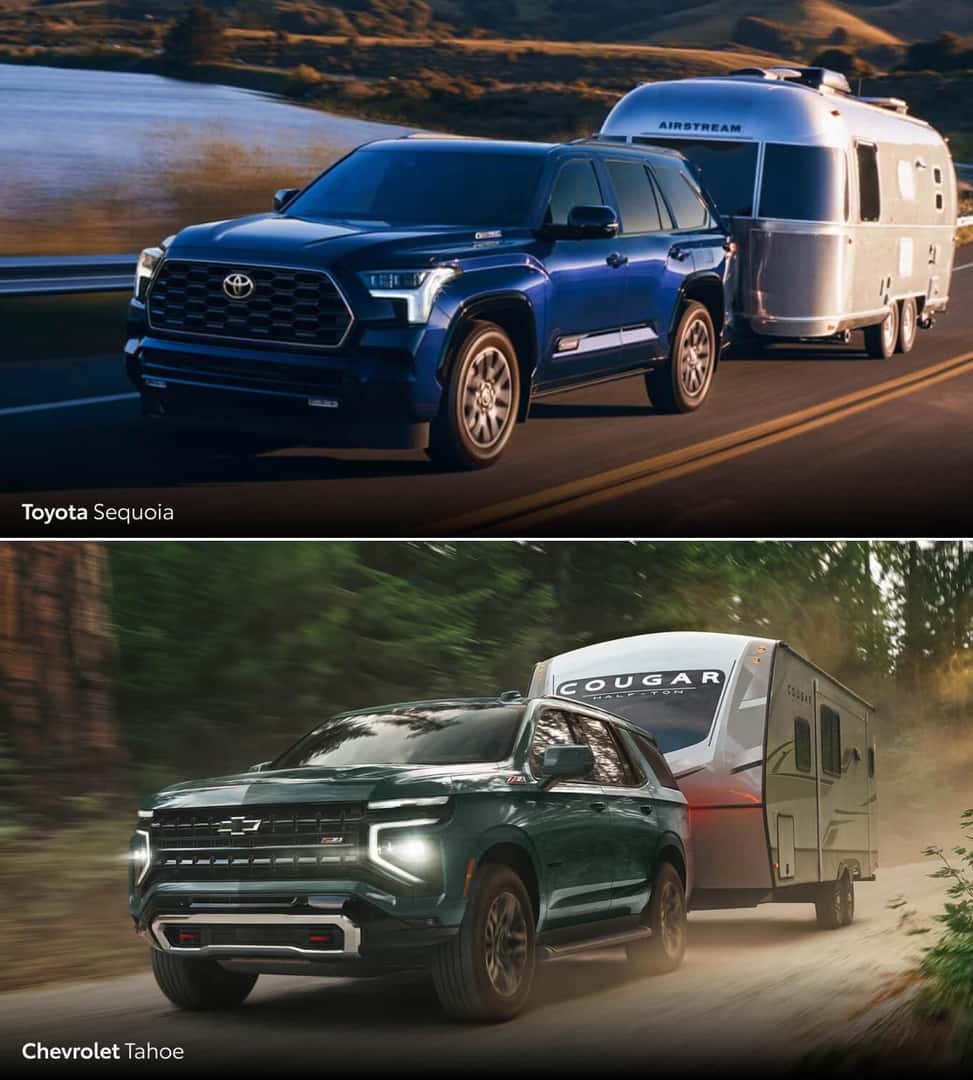
When comparing the Toyota Sequoia vs. Chevy Tahoe, you'll notice that the Sequoia has one engine option, while the Tahoe has three. That doesn't mean the Sequoia is less potent, though. In fact, it's quite the opposite – its single powertrain is brawnier than anything the Chevy vehicle has on tap. The 2026 Toyota Sequoia hybrid i-FORCE MAX 3.5-liter twin-turbo V-6 engine pumps out 437 horsepower and 583 pound-feet of torque, putting you at the helm of a three-row SUV with serious strength.
The Tahoe tries to keep up with the following engine selections:
This means that even the entry-level Toyota Sequoia gives you access to more horsepower and torque output than any model in the Tahoe lineup.
Regarding Toyota Sequoia vs. Chevy Tahoe MPG, these two sport-utes stay pretty close if you're looking at their maximum ratings, with the Tahoe slightly edging out the Sequoia. However, that's only if you choose the turbo-diesel powertrain for the Chevy model – something that many families will have no interest in. When it comes to non-diesel MPG scores, the Sequoia significantly outpaces the Tahoe.
For instance, the Toyota Sequoia delivers a maximum EPA-estimated 21/24/22 MPG (City/Highway/Combined).3 While the 2026 Chevy Tahoe offers up to an EPA-estimated 22/26/24 MPG (City/Highway/Combined)5 with the turbo-diesel engine, you'd only get up to 15/20/17 MPG (City/Highway/Combined)4 were you to choose a gas-powered variant.
Whether you choose a Toyota Sequoia or Chevy Tahoe, you'll get a 10-speed automatic, limited-slip differential, and rear-wheel drive as standard, with the option to upgrade to four-wheel drive.
Both the new Toyota Sequoia and new Chevy Tahoe can haul more than many midsize pickup trucks, but the Toyota SUV still has a significant advantage over its competitor. Specifically, the 2026 Toyota Sequoia offers a maximum towing capacity of 9,500 pounds.1 Meanwhile, the 2026 Chevy Tahoe only manages to pull up to 8,400 pounds behind it.2
Take a look at the Toyota Sequoia vs. Chevy Tahoe trim levels, and you'll see that both SUVs give you a choice of six models. The Toyota Sequoia release date brought with it the following trims:
A Chevy Tahoe can be had in the following trim levels:
The next logical question is: What do the Toyota Sequoia vs. Chevy Tahoe entry-level trims have to offer?
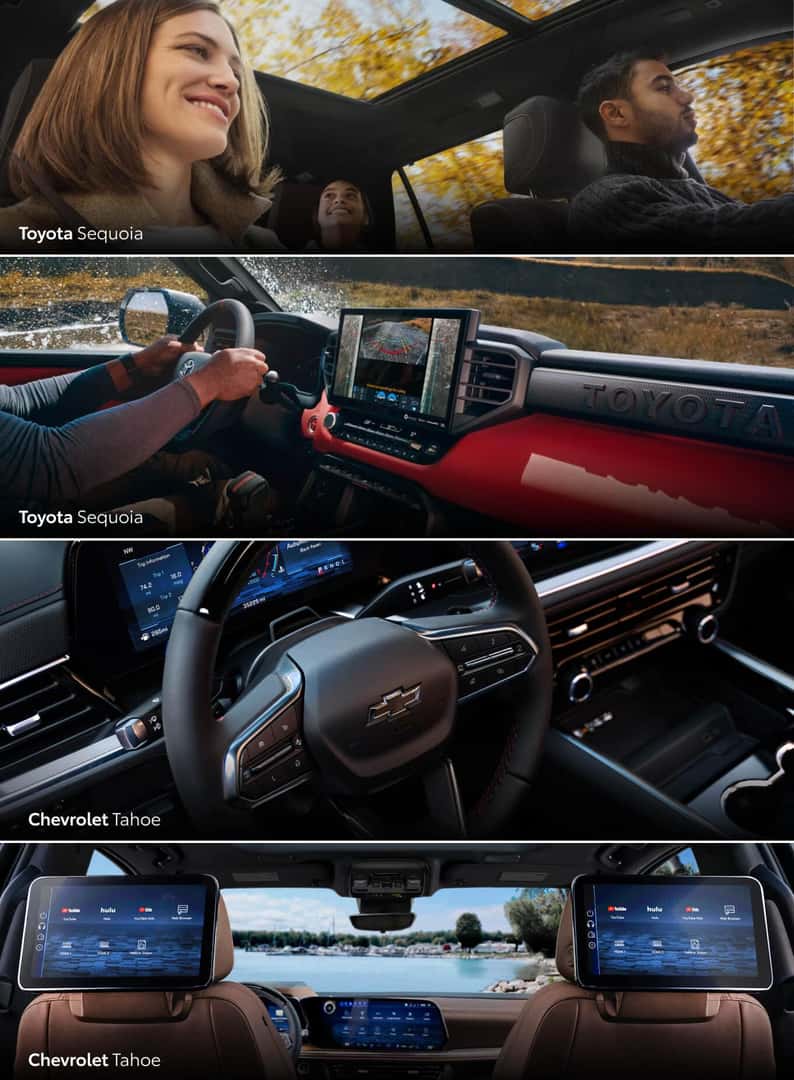
In a Sequoia SR5, you'll find standard 18-inch alloy wheels, three-zone auto climate control, an 8-inch touchscreen infotainment display, wireless Android Auto™ and Apple CarPlay® compatibility, a 12.3-inch fully digital gauge cluster, an eight-speaker sound system, heated front seats, a Panoramic View Monitor, and a power moonroof.
You'll find some similar appointments with the entry-level Tahoe LS, such as 18-inch alloy wheels, three-zone automatic climate control, wireless Apple CarPlay® and Android Auto™ connectivity, and HD Surround Vision. While it has a larger 17.7-inch touchscreen that beats out even the available 14-inch one for the Sequoia, it comes with a smaller 11-inch digital driver information display. It also gives you two fewer speakers and doesn't come fitted with a power moonroof – you'll have to climb the trim ladder to find the latter.
While we must admit that the standard 17.7-inch infotainment system in the Tahoe cabin is appealing, that's about the only advantage it has over the Sequoia. Overall, the Sequoia gives you more right from the get-go.
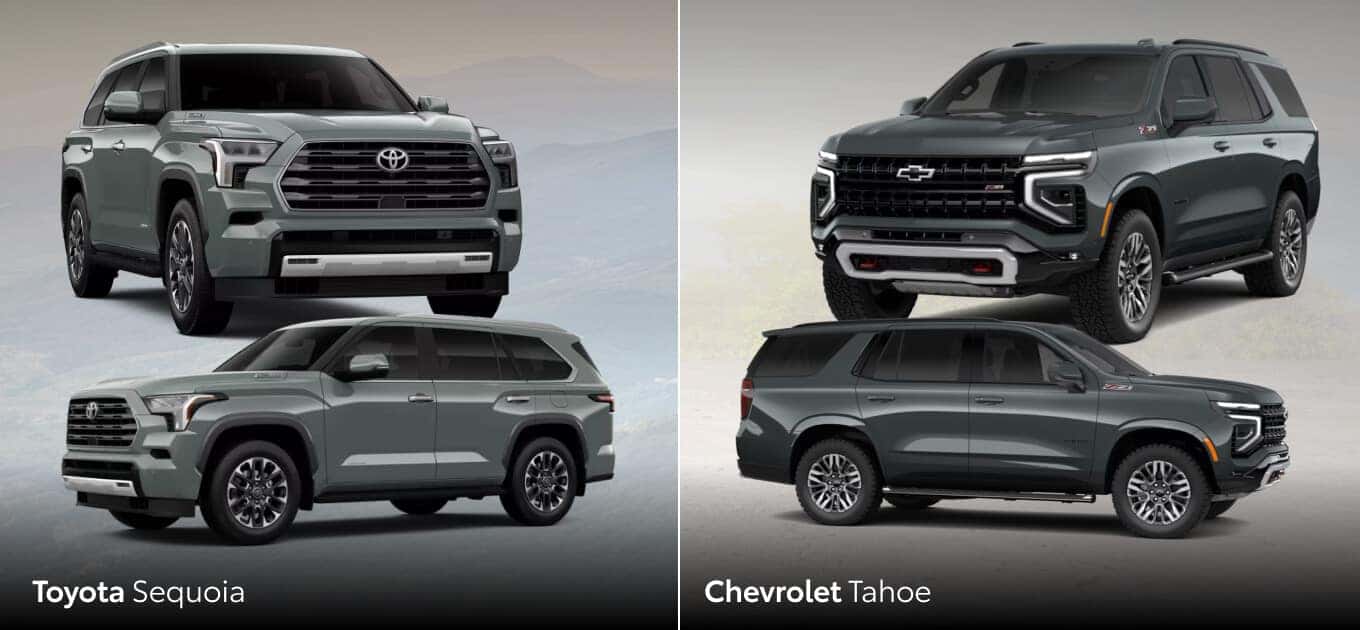
Toyota Sequoia vs. Chevy Tahoe dimensions are similar. Both models are full-size three-row SUVs featuring standard seating for eight occupants. The Toyota Sequoia measures 208.1 inches long, up to 78.9 inches tall (on the TRD Pro), and 79.8 inches wide. The Chevy Tahoe is 211.3 inches long, 81 inches wide, and up to 76.8 inches tall.
With slightly smaller length and width measurements, the Sequoia is a bit more maneuverable around the city while remaining plenty spacious inside the cabin. For example, it has 50.9 inches of third-row hip room, compared to 49.4 inches in the Tahoe.
Now that you've seen how the Toyota Sequoia vs. Chevy Tahoe comparison favors the powerful, efficient, well-appointed Toyota SUV, we invite you to swing by for a test drive if you happen to be in our vicinity. We can help you discover all the other benefits of choosing the 2026 Sequoia. When you do, be sure to speak to our Street Toyota team about lease deals, which can make taking home this family SUV even more accessible.
The 2026 Chevy Tahoe is larger, measuring 211.3 inches long and 81 inches wide, while the 2026 Toyota Sequoia is 208.1 inches long and 79.8 inches wide. However, this makes the Sequoia SUV more nimble for everyday driving around town, school carpools, or wherever else life takes you. It also has more hip room for third-row occupants when compared to the Tahoe.
The Tahoe has about 3.2 cubic feet of extra cargo space behind the third row compared to the Toyota Sequoia, but it offers a far lower maximum towing capacity. To be precise, the 2026 Toyota Sequoia has a maximum towing capacity of 9,500 pounds,1 while a 2026 Tahoe tops out at 8,400 pounds.2 Therefore, weigh both aspects if you have a lot to bring along.
The Toyota Sequoia and the Chevy Tahoe are both safe vehicles with various advanced features to predict and mitigate collisions. Although they vary in naming conventions, both have Blind Spot, Pedestrian, and Forward Collision Detection technologies. That being said, the Sequoia may be ideal as it comes with standard Road Sign Assist, of which the Tahoe has no available equivalent in the lineup.
1Before towing, confirm your vehicle and trailer are compatible, hooked up and loaded properly and that you have any necessary additional equipment. Do not exceed any Weight Ratings and follow all instructions in your Owner's Manual. The maximum you can tow depends on base curb weight plus the total weight of any cargo, occupants, and added vehicle equipment. "Added vehicle equipment" includes additional standard/optional equipment and accessories added by the manufacturer, dealers, and/or vehicle owners. The only way to be certain of your vehicle's exact curb weight is to weigh your vehicle without passengers or cargo. (Calculated with the new SAE J2807 method.) Installation of a tow hitch receiver or other accessories located near the rear bumper or side-door kick sensors may require disabling or removing the kick sensor, and the sensor operation setting in your vehicle should be turned off. See Owner's Manual for limitations.
2Before you buy a vehicle or use it for trailering, carefully review the Trailering section of the Owner's Manual. The weight of passengers, cargo and options or accessories may reduce the amount you can tow.
3Use for comparison purposes only. Your mileage will vary for many reasons, including your vehicle's condition and how/where you drive. See www.fueleconomy.gov.
4EPA-estimated 15 city/20 hwy/17 comb 5.3-liter V-8 or 6.2-liter V-8 FWD.
5EPA-estimated 22 city/26 hwy/24 comb 3.0-liter turbo-diesel FWD.
6This information is not verified by the official manufacturer and shall serve solely as unofficial general information. For details, visit: https://www.caranddriver.com/toyota/sequoia
7This information is not verified by the official manufacturer and shall serve solely as unofficial general information. For details, visit: https://www.caranddriver.com/chevrolet/tahoe